 This is the title of my song and here is an image capturing the darker side of this state.
Wednesday, October 28, 2009
I Want You To Want Me by Anne-Marie Kornachuk
This is the title of my song and here is an image capturing the darker side of this state.


'Those be rubies, fairy favours;'
These are just a few little thoughts for everyone in fairy land....
When the first baby laughed for the first time, its laugh broke into a thousand pieces, and they all went skipping about, and that was the beginning of fairies. And now when every new baby is born its first laugh becomes a fairy. So there ought to be one fairy for every boy or girl.
(James M. Barrie, Peter Pan.)
Up the airy mountain,Down the rushy glen,We daren't go a-huntingFor fear of little men;Wee folk, good folk,Trooping all together,Green jacket, red cap,And white owl's feather!
(William Allingham, The Fairies.)
When I sound the fairy call,Gather here in silent meeting,Chin to knee on the orchard wall,Cooled with dew and cherries eating.Merry, merry, Take a cherryMine are sounder, Mine are rounderMine are sweeter, For the eaterWhen the dews fall. And you'll be fairies all.
(Robert Graves, Cherry-Time.)
Faeries, come take me out of this dull world,For I would ride with you upon the wind,Run on the top of the dishevelled tide,And dance upon the mountains like a flame.
(William Butler Yeats, The Land of Heart's Desire.)
Love Peaseblossom* x
When the first baby laughed for the first time, its laugh broke into a thousand pieces, and they all went skipping about, and that was the beginning of fairies. And now when every new baby is born its first laugh becomes a fairy. So there ought to be one fairy for every boy or girl.
(James M. Barrie, Peter Pan.)
Up the airy mountain,Down the rushy glen,We daren't go a-huntingFor fear of little men;Wee folk, good folk,Trooping all together,Green jacket, red cap,And white owl's feather!
(William Allingham, The Fairies.)
When I sound the fairy call,Gather here in silent meeting,Chin to knee on the orchard wall,Cooled with dew and cherries eating.Merry, merry, Take a cherryMine are sounder, Mine are rounderMine are sweeter, For the eaterWhen the dews fall. And you'll be fairies all.
(Robert Graves, Cherry-Time.)
Faeries, come take me out of this dull world,For I would ride with you upon the wind,Run on the top of the dishevelled tide,And dance upon the mountains like a flame.
(William Butler Yeats, The Land of Heart's Desire.)
Love Peaseblossom* x
Shakespeare's Life and Works and his Contemporaries
Shakespeare’s Life and Works and his Contemporaries
1564 Shakespeare and Christopher Marlowe born. Shakespeare was educated to grammar school level; Marlowe to postgraduate level.
1574 Ben Jonson born. He was educated to degree.
1577 Holinshed “The Chronicles of England, Scotland and Ireland”, the primary source for the history plays.
1582 Shakespeare marries Anne Hathaway.
1583 Birth of Shakespeare’s daughter Susanna.
1585 Birth of Shakespeare’s twins, Judith and Hamnet.
1586 Mary Queen of Scots is executed.
1587 Marlowe’s Tamburlaine was among the first English plays to be in blank verse signalling the beginning of a mature phase in Elizabethan theatre.
1588 Defeat for Spanish Armada.
1588 Marlowe’s Dr. Faustus.
1589 The Comedy of Errors.
1589 Shakespeare moves from Stratford to London to establish himself as an actor and playwright. His family remains in Stratford.
1590 Edmund Spencer’s Faerie Queen (part 1-3) is published. It is an allegory written in praise of Queen Elizabeth. It found such political favour the queen granted him a pension of £50 per year.
1590 Henry VI (part I)
1591 Henry VI (part II)
1591 Henry VI (part III)
1593 Marlowe’s Jew of Malta is published. Thought to be the basis of forthcoming “Merchant of Venice”.
1593 Marlowe dies
1593 Two Gentlemen of Verona
Venus and Adonis is dedicated to Henry Wriothsley, Earl of Southampton, one of Shakespeare’s patrons and addressee of his sonnets.
Richard III
1593 Theatre’s closed due to the plague. Reopened in 1594.
1594 Shakespeare becomes a founding member of the Lord Chamberlain’s Men.
1594 Marlowe’s Edward II is posthumously published.
1594 The Taming of the Shrew
1594 Titus Andronicus
1594 Love’s Labour’s Lost one of a few Shakespeare plays that have no known source for the main plot.
1594 The Rape of Lucrece is much more intimately dedicated to Wriothsley: “The love I dedicate to your lordship is without end ... What I have done is yours; what I have to do is yours; being part in all I have, devoted yours."
1594 The sonnets are written.
1595 Romeo and Juliet
1595 Richard II
1596 Shakespeare’s son, Hamnet, dies
1596 Spencer’s Faerie Queen part (4-6)
1596 King John. This play, written in the year of Hamnets, features a character who suffers the loss of her son. (See Appendix).
1596 Midsummer Night Dream. One of a few Shakespeare plays that have no known source for the main plot.
1596 Merchant of Vince
1596 Henry VI (part I)
1597 Jonson has a fixed engagement in the Admirals Men at the Rose theatre.
1597 Shakespeare buys a cottage in Stratford.
1597 Merry Wives of Windsor
1598 Jonson’s Every Man in His Humour
1598 Henry IV (part II)
1598 Much Ado About Nothing
1599 Globe built
1599 Spenser dies
1599 Earl of Essex sent to Ireland
1599 As You Like It
1599 Julius Caesar
1599 Henry V
1599 Shakespeare becomes a shareholder
1600 The Fortune Theatre opens
1600 Hamlet
1600 Troilus and Cressida
1601 Essex rebels against Elizabeth I
1601 Twelfth Night
1602 All’s Well That Ends Well
1603 Elizabeth I dies. James I becomes king. This is the beginning of the Jacobean era with the new genre: tragicomedy. This was influenced by Marston and Jonson.
1603 Othello
1604 Marston’s The Malcontent published. It was is most successful play, first performed by the Children of the Chapel, a group of boy players as described in Hamlet. This was then performed by the Kings Men, who supposedly stole the play from the younger players.
1604 Measure for Measure
1604 Timon of Athens
1605 The Gunpowder plot
1605 King Lear
1606 Jonson’s Volpone
1606 Macbeth
1607 Pericles
1608 Shakespeare’s mother dies
1608 Anthony and Cleopatra
1608 Coriolanus
1609 Cymbeline
1610 Jonson’s The Alchemist
1610 Winter’s Tale
1610 The Tempest One of a few Shakespeare plays that have no known source for the main plot.
1611 Two Noble Kinsmen
1612 Webster’s The White Devil
1613 Henry VIII
1614 Webster’s Duchess of Malfi
1614 Jonson’s Bartholomew Fayre
1616 Shakespeare dies
1616 Jonson’s Folio published
1623 Shakespeare’s First Folio published with all plays but Pericles, Two Noble Kinsmen, Loves Labours Won and Cardenio.
Appendix:
Edmund Spenser (1552 – 1599) English poet most famous for his incomplete epic poem.
Ben Jonson (1572 – 1637) English poet and dramatist known for his satirical plays. There are many legends about a rivalry between Jonson and Shakespeare including Jonson scoffing over the setting of Winters Tale on a non-existant seacoast of Bohemia. Jonson and Shakespeare debated in the Mermaid tavern in which Shakespeare would outwit the more learned Jonson. According to G.E. Bentley, Shakespeare and Jonson had equal reputations. Jonson was arrested for writing the seditious and slanderous The Isle of Dogs. He was briefly incarcerated again for murder, pleading guilty to manslaughter. By 1620 his work and popularity declined.
Christopher Marlowe (1564 – 1593) an English dramatist, poet and translator for Elizabethan theatre. Foremost Elizabethan tragedian. He was a university educated man (Cambridge, Corpus Christi College). In the year of his death he was arrested for blasphemy (allegedly).
King John: Constance grieves son Arthur
Grief fills the room up of my absent child,
Lies in his bed, walks up and down with me,
Puts on his pretty looks, repeats his words,
Remembers me of all his gracious parts,
Stuffs out his vacant garments with his form;
Then have I reason to be fond of grief.
Fare you well: had you such a loss as I,
I could give better comfort than you do.—
I will not keep this form upon my head,
[Tearing off her head-dress.]
When there is such disorder in my wit.
O Lord! my boy, my Arthur, my fair son!
My life, my joy, my food, my all the world!
My widow-comfort, and my sorrows' cure!
—Constance
Saturday, October 24, 2009
Move over Ken Branagh...
Some of you will have seen this already, but it deserves another look:
http://www.youtube.com/watch?v=SCVc5TaPpe8
http://www.youtube.com/watch?v=SCVc5TaPpe8
Wednesday, October 21, 2009

Sunday, October 11, 2009
Comedy and Tragedy Research

Dramatic Structure: Comedy and Tragedy
Shakespeare's plays are all about one great general theme: disorder. This may sound like a profound statement, but, as we shall see in a moment, it applies equally well to almost all drama. Still, the point is worth stressing, for reasons we shall attend to in a moment, because the major entry into every play we read is going to be an attempt to answer some key questions associated with that notion of disorder: What is the order in this society? How is that order violated? How do the characters respond to the loss of traditional order? How is order restored? Is the new order at the end of the play something healthy or is it shot through with ironic resonance?
All dramatic stories always involve conflict. Typically, the dramatic narrative will open with some sense of a normal society: we see people of all kinds going about their business, and in witnessing this initial state of affairs we quickly ascertain the various ranks of people, the bonds which hold them together, and something about their value system. In other words, we begin with a society which is held together by shared rules. Many of Shakespeare's plays begin with a large group scene (the king and his court, for example) in which everyone has a place and knows his or her place. The scene is offered to us as a symbol of social unity which is about to be broken and will not be restored until the closing scenes (e.g., King Lear, Macbeth, Richard II).
Then, something unusual and often unexpected happens to upset that normality. The event may be something natural, like a ship wreck (as in Twelfth Night or The Tempest), supernatural (as in Macbeth and Hamlet), a decision made by a particular character (as in King Lear or As You Like It) or a sudden quarrel (e.g., As You Like It, Henry IV, Part 1). Often this event which kick starts the action is given very quickly with no attempt to provide a detailed explanation for it or even, in some cases, instantly plausible motivation (e.g., Cordelia's refusal to answer Lear, Oliver's decision to seek Orlando's death). At all events, this upset (which typically occurs very early in the action) disturbs the normal situation, creates confusion and conflict. Such conflict may be the source of much humour (for example, in the various mistaken identities which occur when a set of twins or, as in Comedy of Errors, two sets of twins, unexpectedly get loose in the community), or it may be the source of much political, personal, and psychological torment. Attempts to understand what is going on or to deal with it simply compound the conflict, accelerating it and intensifying it. Finally, the conflict is resolved.
The terms comedy and tragedy commonly refer to the ways in which dramatic conflicts are resolved. In comedy, the confusion ends when everyone recognizes what has been going on, learns from it, forgives, forgets, and re-establishes his or her identity in the smoothly functioning social group (which may return to the original normality or may be setting up a better situation than the one the group started with). Comedies typically end with a group celebration, especially one associated with a betrothal or wedding, often accompanied by music and dancing The emphasis is on the reintegration of everyone into the group, a recommitment to their shared life together. If there has been a clearly disruptive presence in the action, a source of anti-social discord, then that person typically has reformed his ways, has been punished, or is banished from the celebration. Thus, the comic celebration is looking forward to a more meaningful communal life (hence the common ending for comedies: "And they lived happily ever after").
The ending of a tragedy is quite different. Here the conflict is resolved only with the death of the main character, who usually discovers just before his death that his attempts to control the conflict and make his way through it have simply compounded his difficulties and that, therefore, to a large extent the dire situation he is in is largely of his own making. The death of the hero is not normally the very last thing in a tragedy, however, for there is commonly (especially in classical Greek tragedy) some group lament over the body of the fallen hero, a reflection upon the significance of the life which has now ended. Some of Shakespeare's best known speeches are these laments. The final action of a tragedy is then the carrying out of the corpse. The social group has formed again, but only as a result of the sacrifice of the main character(s), and the emphasis in the group is in a much lower key, as they ponder the significance of the life of the dead hero (in that sense, the ending of a tragedy is looking back over what has happened; the ending of comedy is looking forward to a joyful future).
This apparently simple structural difference between comedy and tragedy means that, with some quick rewriting, a tragic structure can be modified into a comic one. If we forget about violating the entire vision in the work (more about this later), we can see how easily a painful tragic ending can be converted into a reassuring comic conclusion.. If Juliet wakes up in time, she and Romeo can live happily ever after. If Cordelia survives, then Lear's heart will not break; she can marry Edgar, and all three of them can live prosperously and happily for years to come. And so on. Such changes to the endings of Shakespeare's tragedies were commonplace in eighteenth-century productions, at a time when the tragic vision of experience was considered far less acceptable and popular by the general public.
All dramatic stories always involve conflict. Typically, the dramatic narrative will open with some sense of a normal society: we see people of all kinds going about their business, and in witnessing this initial state of affairs we quickly ascertain the various ranks of people, the bonds which hold them together, and something about their value system. In other words, we begin with a society which is held together by shared rules. Many of Shakespeare's plays begin with a large group scene (the king and his court, for example) in which everyone has a place and knows his or her place. The scene is offered to us as a symbol of social unity which is about to be broken and will not be restored until the closing scenes (e.g., King Lear, Macbeth, Richard II).
Then, something unusual and often unexpected happens to upset that normality. The event may be something natural, like a ship wreck (as in Twelfth Night or The Tempest), supernatural (as in Macbeth and Hamlet), a decision made by a particular character (as in King Lear or As You Like It) or a sudden quarrel (e.g., As You Like It, Henry IV, Part 1). Often this event which kick starts the action is given very quickly with no attempt to provide a detailed explanation for it or even, in some cases, instantly plausible motivation (e.g., Cordelia's refusal to answer Lear, Oliver's decision to seek Orlando's death). At all events, this upset (which typically occurs very early in the action) disturbs the normal situation, creates confusion and conflict. Such conflict may be the source of much humour (for example, in the various mistaken identities which occur when a set of twins or, as in Comedy of Errors, two sets of twins, unexpectedly get loose in the community), or it may be the source of much political, personal, and psychological torment. Attempts to understand what is going on or to deal with it simply compound the conflict, accelerating it and intensifying it. Finally, the conflict is resolved.
The terms comedy and tragedy commonly refer to the ways in which dramatic conflicts are resolved. In comedy, the confusion ends when everyone recognizes what has been going on, learns from it, forgives, forgets, and re-establishes his or her identity in the smoothly functioning social group (which may return to the original normality or may be setting up a better situation than the one the group started with). Comedies typically end with a group celebration, especially one associated with a betrothal or wedding, often accompanied by music and dancing The emphasis is on the reintegration of everyone into the group, a recommitment to their shared life together. If there has been a clearly disruptive presence in the action, a source of anti-social discord, then that person typically has reformed his ways, has been punished, or is banished from the celebration. Thus, the comic celebration is looking forward to a more meaningful communal life (hence the common ending for comedies: "And they lived happily ever after").
The ending of a tragedy is quite different. Here the conflict is resolved only with the death of the main character, who usually discovers just before his death that his attempts to control the conflict and make his way through it have simply compounded his difficulties and that, therefore, to a large extent the dire situation he is in is largely of his own making. The death of the hero is not normally the very last thing in a tragedy, however, for there is commonly (especially in classical Greek tragedy) some group lament over the body of the fallen hero, a reflection upon the significance of the life which has now ended. Some of Shakespeare's best known speeches are these laments. The final action of a tragedy is then the carrying out of the corpse. The social group has formed again, but only as a result of the sacrifice of the main character(s), and the emphasis in the group is in a much lower key, as they ponder the significance of the life of the dead hero (in that sense, the ending of a tragedy is looking back over what has happened; the ending of comedy is looking forward to a joyful future).
This apparently simple structural difference between comedy and tragedy means that, with some quick rewriting, a tragic structure can be modified into a comic one. If we forget about violating the entire vision in the work (more about this later), we can see how easily a painful tragic ending can be converted into a reassuring comic conclusion.. If Juliet wakes up in time, she and Romeo can live happily ever after. If Cordelia survives, then Lear's heart will not break; she can marry Edgar, and all three of them can live prosperously and happily for years to come. And so on. Such changes to the endings of Shakespeare's tragedies were commonplace in eighteenth-century productions, at a time when the tragic vision of experience was considered far less acceptable and popular by the general public.
Monday, October 5, 2009
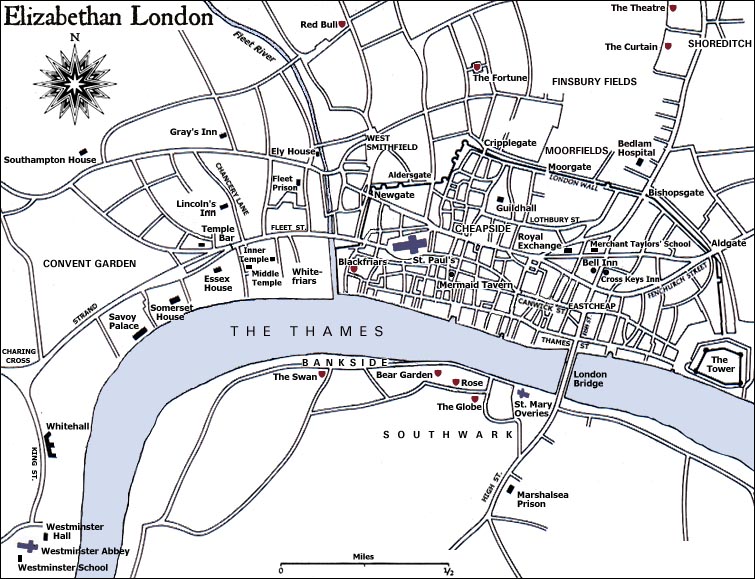
Elizabethan London
Elizabethan London
Shopping in London
Or you can go to the home of that website for more on Elizabethan England.
Shopping in London
Or you can go to the home of that website for more on Elizabethan England.
Factory's Hamlet
Hey all,
Click here for something unique. The Factory's Hamlet, next Sunday under a railway arch in Clapham.
Thanks,
Emma
Friday, October 2, 2009
Mendelssohn and 'The Dream'
i watched this version of 'the dream' on radio 4 and basically it's a rendition of the play but with music by Mendelssohn so if music helps you at all with 'feeling' your way through the play then this could be quite handy, or you can just skip the music bits and watch the acting because i think it's quite inventive what they do with the staging and the script, so yeah, have a gander if you fancy ... here's the link:
http://www.bbc.co.uk/composers/mendelssohn/dream.shtml
http://www.bbc.co.uk/composers/mendelssohn/dream.shtml
A startling revelation
Look at how crazy this is! I can post on here! (it's easy Andy - just click on 'sign in' at the top right of the screen and it takes you to the right page). The unedited info from our presentation is in the my documents folder on the Mountview desktop under John Wilkinson. The file is called 'Elizabethan Playhouses' (it won't let me paste it to the blog). You should also have a look at Bill Bryson's book on Shakespeare and this website -
www.globe-theatre.org.uk/globe-theatre-actors.htm
as it has biographies of actors and lots of other stuff
Go to this link if you want to see my character animal.
http://en.wikipedia.org/wiki/File:Bubo_virginianus_nacurutu_-_Otter,_Owl,_and_Wildlife_Park.jpg
and check this out if you are not yet scared of Peter O'Toole...
http://www.youtube.com/watch?v=ryVhaJnhLFE
www.globe-theatre.org.uk/globe-theatre-actors.htm
as it has biographies of actors and lots of other stuff
Go to this link if you want to see my character animal.
http://en.wikipedia.org/wiki/File:Bubo_virginianus_nacurutu_-_Otter,_Owl,_and_Wildlife_Park.jpg

and check this out if you are not yet scared of Peter O'Toole...
http://www.youtube.com/watch?v=ryVhaJnhLFE
Globe Trip
Hi Folks,
I propose a trip to the Globe before the season finishes, next Thursday 8th October, to see the 2pm matinee of 'As You Like it'. Click here for info. I have reserved £5 standing tickets.
We can also try and get there an hour earlier to see the exhibition, which I think will be most informative. Tickets for this will be £4 (reduced from £10).
Thanks,
Emma
Thursday, October 1, 2009
Term Plan and Scene Selections
Shakespeare Project – TERM PLAN 2A2
Hello all,
As promised, below is the overview of the term and rehearsal schedule. There is also a scene allocation below. Please note, all details are subject to development and change.
| Week | Task |
| 1 (28/9) | Mon: Scene Reading and discussion Thurs: research presentation: 1 (The Elizabethan Playhouse – Alice & John) Character work Fri: Research Presentation 2 (Comedy/Tragedy – Nicky & Dean) Character, text and ensemble work |
| 2 (5/10) cuts complete | Mon: Research presentation 3: (Shakespeare’s life of work – Funmi & Liam) Scene work: Hamlet (1) Dream (1) Thurs: Research presentation 4: (Elizabethan London – Rachael & Andy) Scene work: Hamlet (2) Dream (2) Friday: Research presentation 5 (Queen Elizabeth, politics 17th century – Cat & Luke) 6 (Shakespeare the man – Dom, Dan, Emma) Scene work: Run back on all scenes, and if time Hamlet (3) |
| 3 (12/10) | Mon: Scene work: Hamlet (3) Dream (3) Thurs: Scene work: Hamlet (4) Dream (4) Fri: Consolidate all scene work thus far |
| 4 (19/10) | Mon: Scene work: Hamlet (5) Dream (5) Thurs: Scene work: Hamlet (6) Dream (6) Fri: Consolidate all scene work thus far |
| 5 (26/10) | Mid Term – No timetable |
| 6 (2/11) | Mon: Scene work: (Hamlet 7) Stagger through all scenes, guage timings, make additional cuts if necessary Thurs & Friday: Back to start, revisit scenes for detail, refinement, development |
| 7 (9/11) | Scene and character development work Detail TBC |
| 8 (16/11) | Scene and character development work Detail TBC |
| 9 (23/11) | Scene and character development work Detail TBC Runs/dress runs |
| 10 (30/11) | Production Week Final Showing: 3/12/09 |
Scenes:
Hamlet
| (1) Act 1 Sc 2 Court scene News of apparition | Claudius Laertes Polonius Hamlet Gertrude Horatio Marcellus | John Liam Funmi Cat Alice Luke Emma |
| (2) Act 2 Sc 1 (p.100-101) “How now Ophelia, what’s the matter?” | Polonius Ophelia | Rachael Nicky |
| (3) Act 2 Sc 2 (p.109-115) “words, words, words” | Polonius Hamlet Guild Ros Gertrude (hidden) Claudius (hidden) | Funmi Dean Andrew Dan Alice John |
| (4) Act 3 Sc 1 (P.124-128) “Get thee to a nunnery” | Hamlet Ophelia Polonius Claudius | Cat Nicky Rachael John |
| (5) Act 3 Sc 4 (P.146-154) Chamber scene “Now mother, what’s the matter” | Gertrude Hamlet | Alice Dean |
| (6) Act 4 Sc 5 (P.166-170) “Where is my father” | Laertes Claudius Ophelia Gertrude (crowd/onlookers) | Liam John Nicky Alice |
| (7) Act 5 Sc 2 (P.188-191) | Horatio Hamlet | Luke Cat/Dean (TBC) |
The Dream (6 Scenes)
| (1) Act 1 Sc 1, p.49-54 Intro of the lovers | Helena Hermia Demetrius Lysander | Funmi Emma Liam Andrew |
| (2) Act 2 Sc 1, p.58-63 “Ill met by moonlight” | Puck Titania Oberon | Dom Rachael Dan |
| (3) Act 2 Sc 1, p. 63-65 “I love thee not” | Demetrius Helena | Liam Funmi |
| (4) Act 2 Sc 2, p.68-72 Lovers confusion | Puck Lysander Hermia Demetrius Helena | Dom Andrew Emma Liam Funmi |
| (5) Act 3 Sc 1, P.77-84 Titania’s Dream | Bottom Titania Oberon Puck Fairies | Nicky Rachael Dan Dom Company |
| (6) Act 5 sc 1, P. 121 Puck’s speech “If we fairies have offended” | Puck | Dom |
Subscribe to:
Posts (Atom)